
The Evangelical Persecution Complex: Part 3 - Onward Christian Soldiers
Soldiers, knights, contenders and keepers

Hello everyone, welcome back. Looks like three new subscribers since my last post. Welcome. Happy to have you here.
This is the third and final installment of my series on the Evangelical Persecution Complex. I've got a new series in the works that will kick off in a couple weeks. I'm pretty excited about it.
Next week I'm posting some supplementary info as a capstone to this series, and I'd also like to do a Q&A. So, if you have any questions, either related to these three essays or about anything else, send 'em my way. If you use the Substack app, you can just leave your questions as a comment on this post. Otherwise, simply reply to this email. I look forward to hearing from you.
Alright then, here's part three.
Onward Christian Soldiers
I mentioned in my introduction post that part of my day as a homeschooled kid was spent singing church songs. I don't remember all of the songs. But I remember this one: the 1865 hymn "Onward, Christian Soldiers, Marching as to War" by S. Baring-Gould.
Onward, Christian soldiers,
marching as to war,
With the cross of Jesus
going on before!
Christ, the royal Master,
leads against the foe;
Forward into battle,
see his banner go!
"Onward Christian Soldiers" is Baring-Gould's most famous piece of writing. The song has a history of being repurposed for political use, and not always by the side you might expect. In fact, the appropriation of "Onward…" by Christian Nationalists is a relatively recent phenomenon. The first politician to use the song was Teddy Roosevelt: "Onward…" became his theme when he was seeking a third term in 1912 under the newly formed Progressive Party, also called the Bull Moose Party (which sounds way cooler).
The delegates adopted “Onward, Christian Soldiers” as their anthem. In addressing the delegates, Roosevelt compared the coming presidential campaign to the biblical Battle of Armageddon and stated that the Progressives were going to “battle for the Lord.” (source: Politico)
The song held a place in other populous movements as well, including the Civil Rights movement in 1969. But it won't come as a shock to you that this is not the context in which my siblings and I sang the words every morning. We were told that until the return of Christ, Christians are in a perpetual state of war with the world, that non-believers hate Christians, and that the life of a Christian was a life of struggle.
A Knight in Shining Plastic Armor
The militant themes in "Onward…" made it a controversial song, and there were even attempts to pull it from popular hymnals about 50 years ago. But in my family, the language of war was a feature, not a bug. Military imagery was common in our household, due in part to my dad's 20+ years of service in the Army, but I suspect it was also common among other church-going kids. For example, I'm sure many folks who grew up in evangelical homes, particularly boys, remember the Full Armor of God. Of course, this is a reference to a Bible verse from Ephesians. But in our hyper-consumerist culture, that Bible verse needed a material manifestation, and it took the form of a plastic play-set Christian parents could buy for their (male) kids. It is still sold at, of all places, Walmart, which advertises the play-set on their website as a "Christian Character-Building Costume."
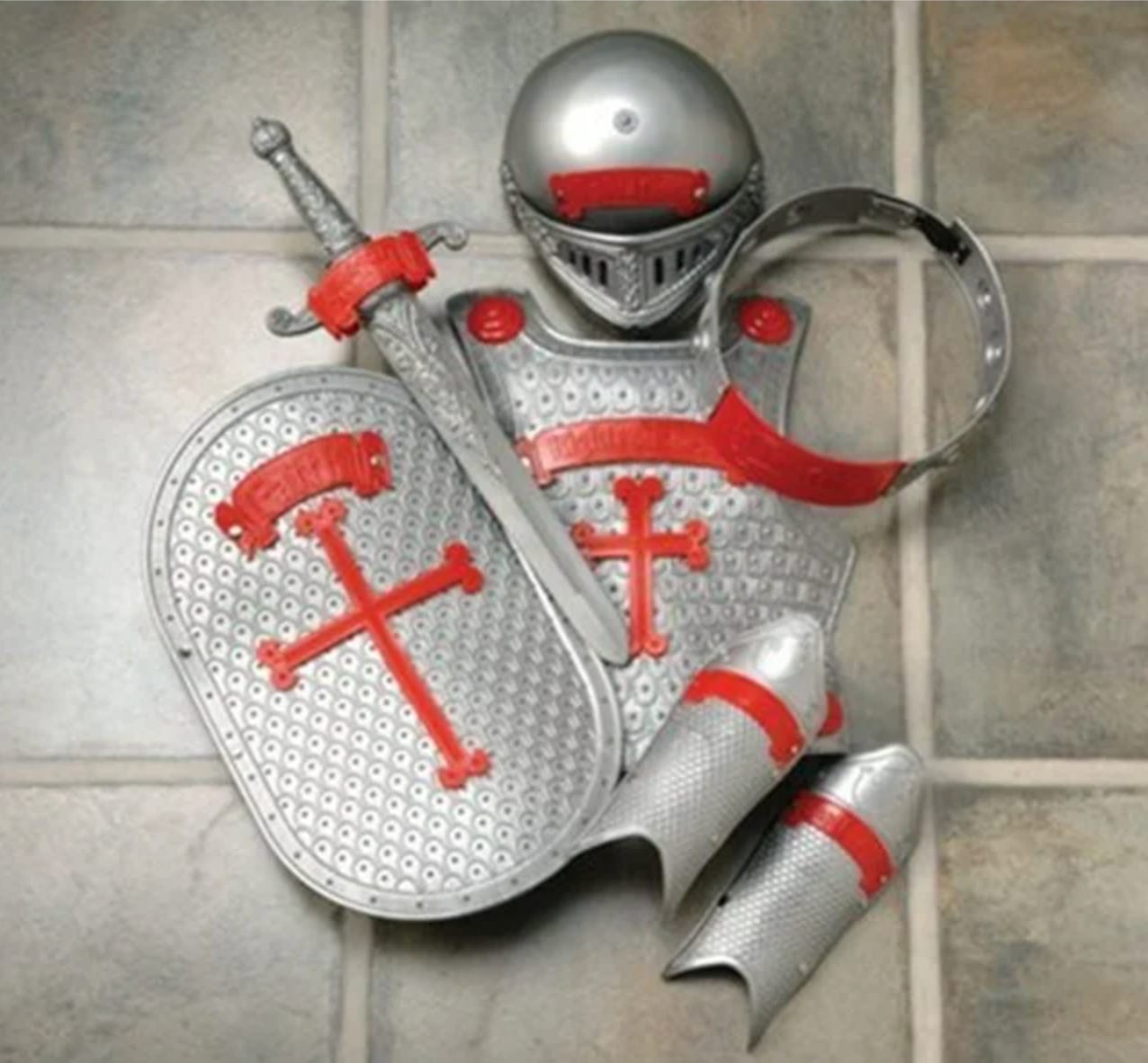
To an outside observer, it's just a cheap knight costume, not unlike the kind you could buy at any Spirit Halloween store. But in Christian households, this plastic imitation of medieval war tools is usually given to young boys alongside a lecture from dad referencing the aforementioned verse. The lesson is that the world will try to beat your faith out of you; with temptations, with distractions, and even with persecution. You must be on guard at all times, to defend the Christian faith both for yourself, for your family, and for your country.
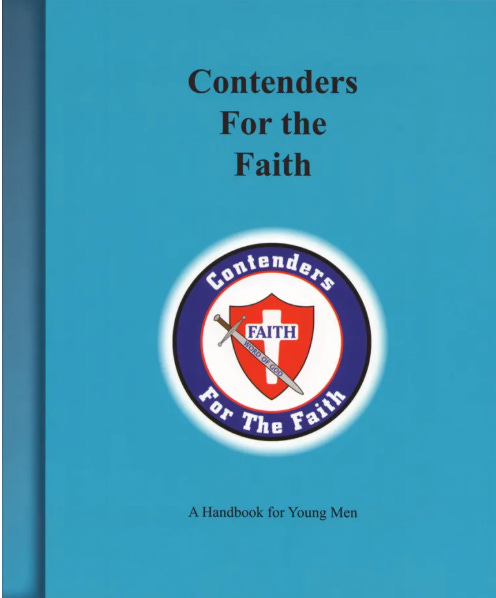
It doesn't stop at early childhood. When those young boys outgrow their Christian Character-Building Costume, the next step is to sign them up for Contenders for the Faith, a Christian Nationalist answer to Boy Scouts. The handbook for Contenders outlines instructions on everything from making homemade ice cream, to first aid, to puppetry. But sprinkled all throughout is some direction that is a little more…pointed. There's a chapter on Bible verse memorization, a chapter on the importance of church. Then there's a chapter on how to ice skate. How to play chess. A chapter on how to be a "prayer warrior" (more military imagery). A chapter on how to make a kite. A chapter on how to use a pocketknife. A chapter on American Patriotism. A chapter on pottery. A chapter on how to cook over a campfire. A chapter on the importance of supporting missionaries in their quest to spread American Evangelicalism to across the globe. A chapter on canoeing. You get the idea.
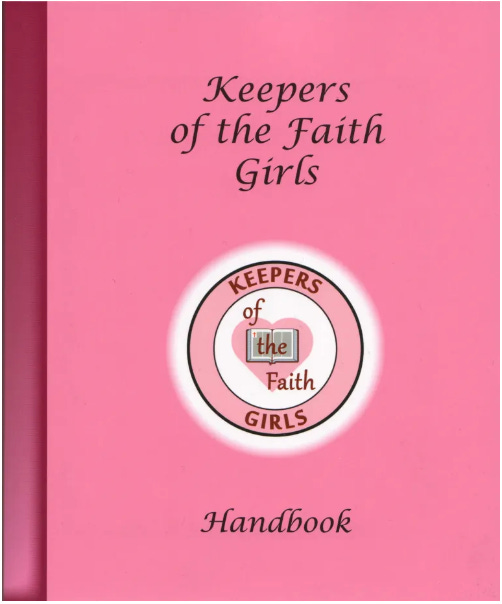
There's also a program and corresponding handbook for girls called Keepers of the Faith. It has some of the same chapters on patriotism, prayer, and puppetry, but a widely expanded section on the culinary arts. It's an obvious plea to return to traditional gender roles. Men are the defenders; women the home keepers. Even the contrasting covers on the handbooks point to a culture in which there is no room for any nuance in discussions around gender.
Beneath this cartoonishly-archaic presentation of gender roles, the underlying premise of Contenders and Keepers—which I myself never participated in, but my younger siblings did—is that children need to be trained for a life of service to and defense of the Christian faith, prioritizing their religion over the rights of others in the process.
“They shot at me”
Contenders and Keepers is a fairly niche program. I'd guess the vast majority of American Evangelicals, outside of some fringe homeschool communities, haven't even heard of it. But the broader message, that the Christian faith is under attack and needs to be protected, is much more widespread. And unfortunately, many grifters have figured out how to exploit this for financial and political gain.
That's why the Trump assassination attempt is such a big deal. Evangelicals believe he is the only thing standing in between them and the people who want to rid the country of so called traditional Christian values. So, when they see an act of violence against him, they view it as an attack on themselves. On the July 19th episode of The Daily, a popular podcast by the New York Times, a person interviewed at the RNC said something quite revelatory: "I believe that, when they shot at [Trump] on Saturday, they shot at me."
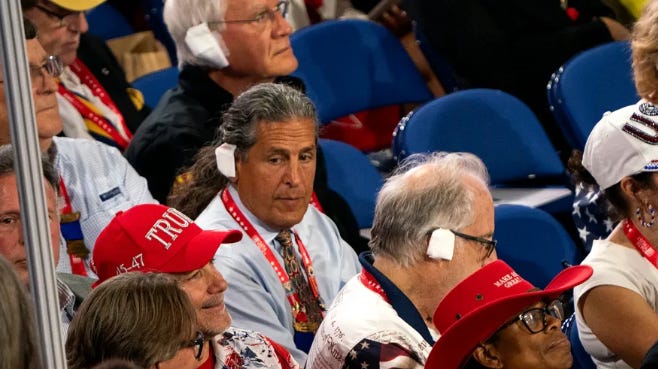
Because they've been conditioned from childhood to see the world through an “us versus them” lens, the Evangelical Right perceives any attack on their religious or political leaders—whether real or imagined—as violence against themselves. When Trump was shot, a lot of people took it personally. They put those tacky bandages over their ears at the RNC to show solidarity with him in what they believe is his noble crusade to save America.
And what happens when those same people have been indoctrinated with military jargon their whole lives and told that they need to defend American Evangelicalism at all costs? What if they've actually had some military training? Did you know there are Christian Military Boot Camps, often aimed at "troubled boys," where they do the same sort of drills and combat training as a robust militia? One such camp in Florida advertises itself on it's own website as "A Military-Like Boarding School for Struggling Teenage Boys."
What if I told you similar camps are everywhere?
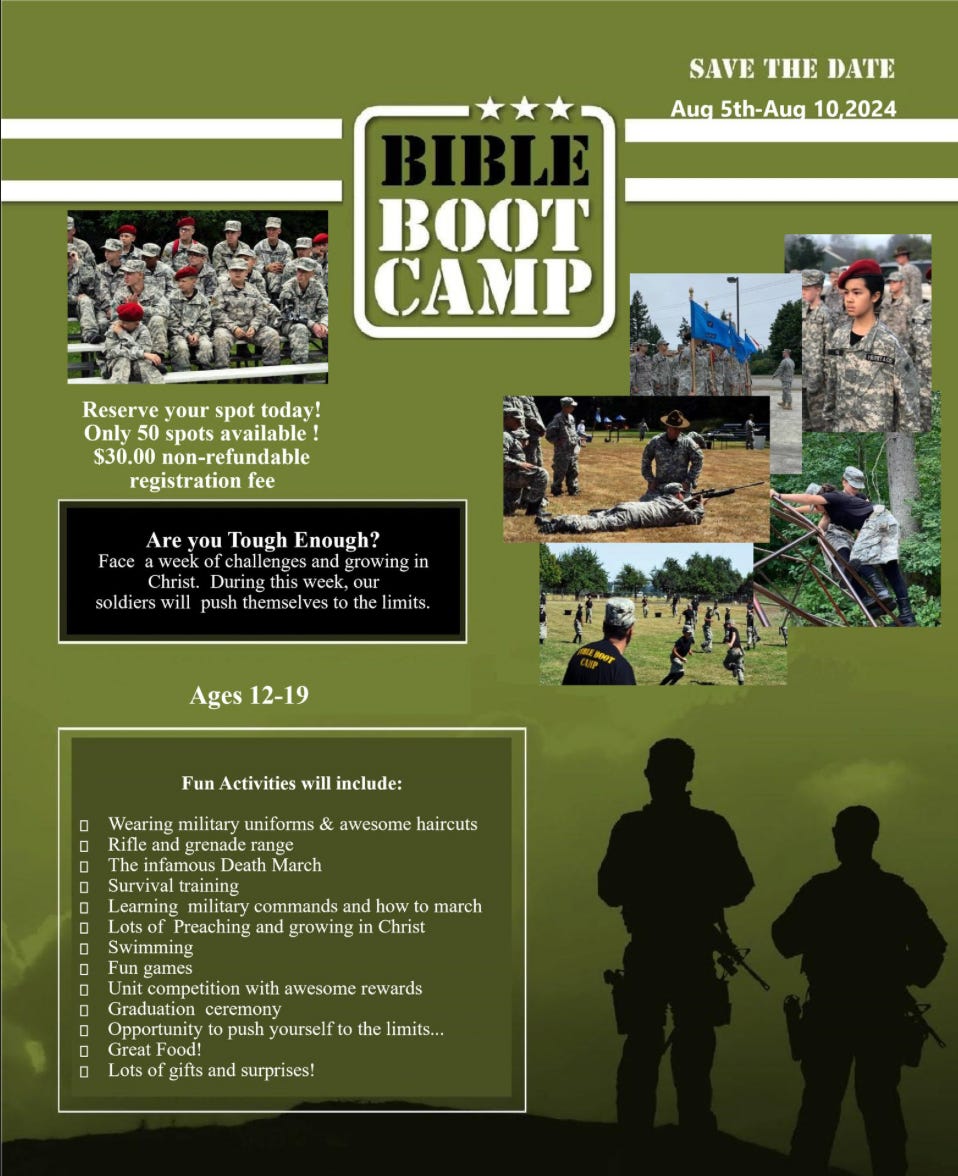
I don't want to sound overly alarmist here. I don't believe the United States is heading for a second Civil War or anything like that. But I am genuinely concerned that decades of radicalization within Evangelical circles has created a bubble that is about to pop. And when that happens, communities that have been the target of Evangelical scapegoating are going to bear the brunt of that harm. As I indicated in my last newsletter, I think transgender people, who already experience a lot of violence in the United States, are particularly vulnerable.
I think it's telling that there was a collective sigh of relief in queer circles when Trump's attempted assassin was reported to be a straight cis man. I spoke to a trans friend on the phone a week after the shooting. They expressed how anxious they were before the identity of the shooter was revealed. I saw the same sentiment echoed among trans folks in various online communities I'm a part of.
In other words, they were afraid that if that shooter had been a trans person, the Evangelical Right and other Trump supporters would use that as an excuse to unleash unprecedented violence against them. I don't think their concerns are unfounded. Despite the identity of the shooter being public knowledge at this point, some right wing conspiracy theorists are still spreading misinformation that he was someone he's not. They want to be able to use him as a scapegoat so badly that they're grasping to repaint the narrative so that it fits their own.
Wrapping it all up
I keep bringing up the trans community because that is where I believe American Evangelicals are directing most of their aggression at this moment in time. If you re-read this series a few years from now, it could be a different group of people. It was Muslims in the 2000's, now it's trans people, and ten years from now some other group will be the primary scapegoat of white Evangelicals.
But while the paint may change over time, beneath the hood, the engine of the Evangelical Persecution Complex will be the same. It runs on a cocktail of prejudice, existential anxiety, and a distorted perception of reality. I don't know how to solve a problem like the Evangelical Persecution Complex, but I think a good first step is to call it out wherever we see it. And above all else, we need to protect the people in our communities who are victims of right-wing Evangelical scapegoating. Protect Trans Lives needs to be more than just a slogan; we must put real action behind those words.
Thanks for reading. I know this subject matter was heavy. My next series will be more fun, I think. I’m having a lot of fun working on it, and am excited to share it with you in a couple weeks. In the meantime, send your questions in by this Sunday to be included in the Q&A next Tuesday. See you then. Be good.
-John from A Broken Arrow
This has been a well written and important series, on a subject many of us (who have not had a lot of contact with Evangelicals) know little or nothing about. I would suspect that this piece was a bit challenging for you to write. I also suspect that there was a good deal of healing, for you, that came out of discussing this topic in an open forum. I look forward to your next post.
Fascinating. Thanks, John!